Your web product has real users and your data tells you a meaningful share of them would use a mobile version. You have postponed mobile because you do not have a mobile team.
Mobile Development for Web-First Companies
A production-ready iOS and Android app, sharing infrastructure with your web stack, in 6 to 12 weeks.
For SaaS and consumer companies with web traction who need a real mobile app, not a wrapped web view.
Fixed price, fixed milestones. We take your existing API, your existing auth, and your existing data model and build a native-feeling React Native app on top of them. You ship to both stores by week 12 with telemetry from day one, and your web product keeps moving while we work.
Products we've built and shipped





- Bookvid

- Alight






Is this you?
When the mobile build is the right next step.
You have tried a wrapped web view or a hybrid build before and got burned. You want a real React Native app this time, not a webpage inside a shell.
You want mobile-specific surfaces (push notifications, biometrics, camera, offline) that your web app cannot do, and the value of those surfaces is what is driving the mobile decision.
You want a mobile app that you can take to an investor, an acquirer, or a board, and the bar is "shipped to both stores with real users", not "demo on TestFlight".
The deliverable
A real mobile app on your existing stack, in both stores.
- A production-ready iOS and Android app built with React Native (and Expo where the workflow fits), connected to your existing backend
- Mobile-specific surfaces wired up: push notifications, deep linking, biometric auth, camera, file pickers, offline-capable views where it matters
- A consistent design system shared between mobile and web where possible, or a mobile-native design where the surfaces diverge
- App Store and Play Store submission, including the visual assets and store metadata (screenshots, descriptions, privacy nutrition labels)
- Telemetry and analytics integrated with your existing stack (or a fresh setup if you do not have one)
- A 30-day post-launch support window: bug fixes, store reject cycles, and a hand-off plan
How it works
Twelve weeks, four phases.
01
Weeks 1 to 2
Product scoping and architecture
We map your existing web stack, your API surface, and your auth and data model. We pick the React Native architecture (Expo managed, Expo bare, or vanilla). We agree on what is shared with web and what is mobile-native.
02
Weeks 3 to 6
Core build
Auth, primary screens, navigation, the first set of mobile-specific surfaces. End of week 6: working build on test devices, primary user flow demoable.
03
Weeks 7 to 10
Secondary surfaces and polish
Push notifications, deep linking, biometrics, offline, polish on the primary surfaces. End of week 10: TestFlight-ready build.
04
Weeks 11 to 12
Submission, launch, hand-off
App Store and Play Store submissions, reject cycles, marketing site updates if needed, analytics validated, hand-off call.
For products with a thinner scope (read-only mobile companion, single primary surface), the build can compress to 6 to 8 weeks.
Pricing
Fixed price, fixed milestones.
- Duration
- 6 to 12 weeks, fixed at scoping
- Price
- $25K to $75K, fixed band; final price set at scoping based on feature scope, platform count, and mobile-specific surface count
- Included
- Mobile (iOS + Android), integration with your existing backend, store submission, 30-day post-launch support
- Excluded
- Backend rewrites (we work with your existing API); web-side work; sustained engineering after the 30-day window (covered by Embedded Team retainer)
FAQ
Common questions.
Why React Native and not native?
React Native gives you a single codebase across iOS and Android, with about 80 to 90% shared code in practice. Native is the right call for performance-critical surfaces (games, AR, heavy media) or where your team is already native-staffed. We will say so if your project is one of those.
What if our backend is not ready for mobile?
We will flag the gaps during Phase 1 scoping. Common gaps: API not versioned, auth tokens not refresh-capable, no push notification infrastructure. Sometimes these get scoped into Phase 2; sometimes they belong upstream of the mobile build.
Can you add AI features to the mobile build?
Yes, but if AI is a primary surface for the product, the AI-Native MVP page is the better starting point. If AI is one feature inside a broader mobile build, we scope it into the milestone plan.
What about Expo vs bare React Native?
Default to Expo managed workflow. We move to bare workflow when the app needs native modules Expo does not support out of the box. Decision made in Phase 1.
Who owns the code?
You do, in your repository, under your license.
Will it look native?
The app uses platform-native components where it matters (navigation, modals, form inputs, alerts) and a shared design system where it does not. The goal is "feels native on iOS, feels native on Android", not "looks identical on both".
App Store and Play Store accounts?
You hold both. We work inside your accounts during the build.
Case study spotlight
A worked example.
Our work on The LYVE App included a full end-to-end build: iOS app, Android app, marketing landing page, and an admin panel, on a single React Native plus Expo codebase against an Express plus GraphQL backend.
The team shipped to both stores in 3 to 4 months and stayed engaged through the first thousand users. The same engagement shape is what we use for web-first companies extending into mobile.
Read the full LYVE case study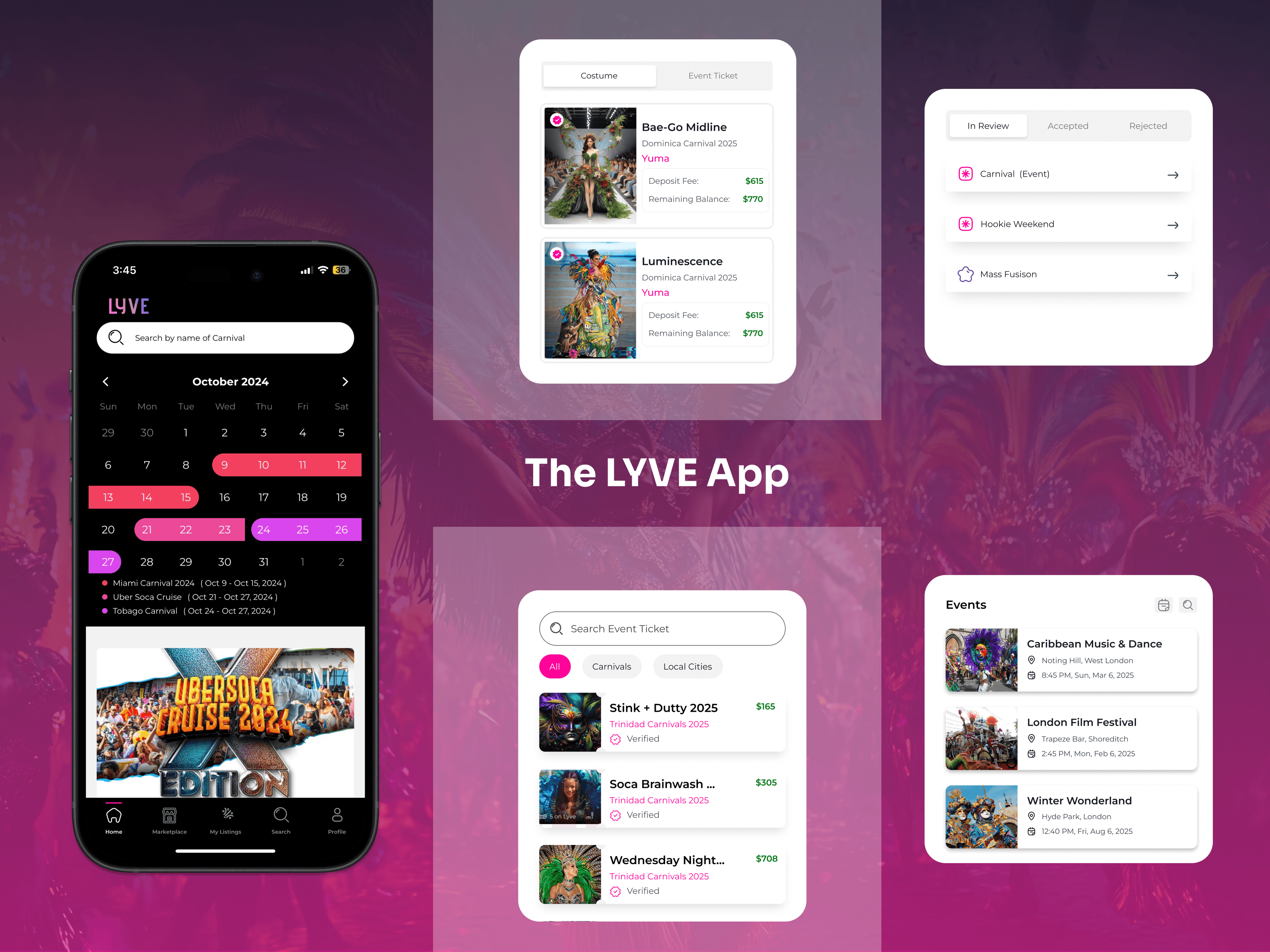
A real mobile app, on your stack, in 12 weeks.
Send us your API docs and your roadmap. We will tell you what 12 weeks gets you.
Plan a mobile build